
Elizabeth Harrison’s Writings
Biography in Brief
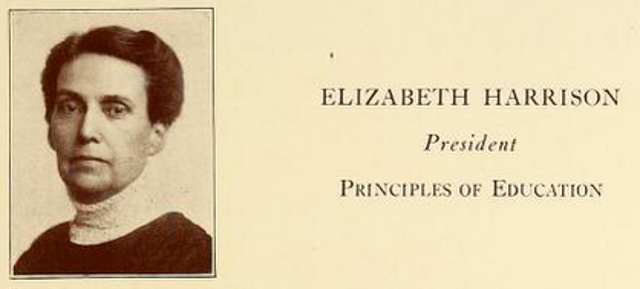
Image: Elizabeth Harrison in NaKinCo, Volume Two of the Year Book of the National Kindergarten College, 1918.
Elizabeth Harrison was born in Athens, Kentucky, September 1, 1849. At an early age, her family moved to Midway, Kentucky, and in 1856 to Davenport, Iowa. From her childhood, she suffered from poor health: chronic asthma and bronchitis, and in later years from recurring pneumonia.
In Davenport, she attended public schools and graduated from the local high school, whose faculty and administration were populated by the “Acht und Verzigers,” Germans who immigrated following the 1848 revolution in Germany. However, her father’s business reversals prevented her from attending college, and she devoted the next years of her life to caring for her sisters’ children in Marshalltown, Iowa.
In the summer of 1879, Harrison visited a high school classmate living in Chicago who persuaded her to attend the kindergarten training class organized by Alice Putnam. Putnam had opened the first kindergarten in Chicago in 1874 and began offering courses in her Kindergarten Training School at the Loring School on Prairie Avenue, Chicago, in 1879 (the following year Putnam founded the Chicago Froebel Association). Harrison returned to Chicago in September 1879 to attend Putnam’s Training School, completed the 36-week training course, and received both a diploma and a certificate to train kindergarten teachers.
In 1881-82 Harrison attended Susan Blow’s school in St. Louis, the first public kindergarten in the United States, which opened in 1873. In order to pay for her attendance at Blow’s school, Harrison opened a summer kindergarten in Marshalltown, Iowa, and in six months Harrison completed the two-year program. The following year she returned to the Loring School but almost immediately traveled to New York to study with Maria Boelte and her husband John Kraus. In 1854-56 Boelte had studied with Frau Louise Froebel, the widow of Frederich Froebel (1782-1852, founder of the kindergarten movement in Germany). Thus, within three years, Harrison had studied with the pioneers of the kindergarten education movement in the United States.
After returning to Chicago in 1883, Harrison and Putnam organized the Chicago Kindergarten Club, which initially attracted 30 members. The following year, Harrison began offering mothers’ classes to educate parents about the kindergarten, and in the fall of 1885 or 1886—National-Louis University and its predecessor colleges traditionally have traced their origins to the latter date, but the sources are contradictory—Miss Harrison’s Training Class (or School) opened with five students and two mothers.
By 1887, there were 48 kindergartens in Chicago and its suburbs (private, church, settlement house, and the first in a public school) and four kindergarten training schools. Harrison soon met Mrs. John N. (Rumah) Crouse—wife of a prominent Chicago dentist, founder and president (1877-1907) of the Women’s Baptist Home Missionary Society in Chicago, and mother of one of Harrison’s kindergarten students—and the two women began planning an expanded curriculum. By 1889 they had opened the Chicago Kindergarten Training School in the Chicago Art Institute, at Michigan Avenue and Van Buren Street. Although they shared many of the responsibilities of operating the school, Harrison focused on teaching and publicizing the kindergarten programs while Mrs. Crouse attended to the financial management, publicity, student recruitment, facilities management, and fund raising for the school.
Eighteen eighty-seven also saw the first of several literary schools, focusing on various historical literary figures, sponsored by the Chicago Kindergarten Club and the Chicago Kindergarten Training School. These began to attract the notice of the local Chicago newspapers. In 1889, Harrison began to offer courses in Milwaukee, Wisconsin, for kindergarten teachers and mothers, and in 1890 she traveled to Germany to meet with Baroness Bertha von Marenholtz-Bulow and Henrietta Breyman Schrader, a niece of Froebel, and visited the Schrader Kindergarten Training School.
Harrison played a major role in the kindergarten exhibit at the World’s Columbian Exposition in Chicago in 1893. By then, there were 100 kindergartens in the Chicago area, and Chicago Kindergarten College students were supervising 50 of them. In 1894 Harrison organized the first national Mother’s Convocation in Chicago, forerunner of the Parent and Teachers Association (PTA), which drew 1,200 attendees. She was becoming a national figure.
At the turn of the 20th century, there were more then 5,000 public school kindergartens in the U.S. and more than 200 kindergarten training schools, and Chicago Kindergarten College alumni were holding positions of influence in the state and local Normal Schools, which were beginning to graduate kindergarten teachers.
Harrison was a founding member of the International Kindergarten Union in 1892, and in later years charted a moderate course between the conservative (strictly Froebelian) wing of the kindergarten movement, represented by Susan Blow, and the more liberal wing associated with John Dewey.
In 1912-13 Harrison visited Rome to observe the school of Maria Montessori, and in 1914 her study of the Montessori Method was published by the U.S. Bureau of Education. The following year the National Kindergarten College, successor to the Chicago Kindergarten College, began offering classes in the Montessori Method.
In 1917, a Children’s School was opened under the supervision of Clara Belle Baker, the younger sister of Edna Dean Baker, who had become Associate President of the National Kindergarten and Elementary College and would succeed Elizabeth Harrison as its president in 1920.
Following a heart attack in 1919, Elizabeth Harrison retired as president of the National Kindergarten and Elementary College in 1920. She spent the remaining years of her life principally in San Antonio, Texas, occasionally traveling to other parts of the U.S. Until the end of her life she revised her memoir, Sketches Along Life’s Road, which was eventually published in 1930, three years after her death on October 31, 1927.





-

Relationship Between the Kindergarten and Great Literature: Homer
Elizabeth Harrison
Harrison discusses how the study of Kindergarten focuses on the influence of environment and the evolution in character. She compares the work of Homer as being relevant to Kindergarten thought due to his depictions of institutions that have grown out of human relationships.
-

Relationship Between the Kindergarten and Great Literature: Shakespeare
Elizabeth Harrison
Harrison discusses how Shakespeare's use of environment sheds light on character building. She describes how through his work, he displays " clear insight into the magnitude of the ethical world, the duty of each individual to consider himself as a necessary portion of a might whole" (pg. 13). Harrison also makes comparisons Froebel's ideas through Shakespeare's work.
-

Science Lessons: Kindergarten Talks and Tales
Elizabeth Harrison
Elizabeth Harrison suggests various science lesson plans for children that relate to the fields of Zoology, Geology, and Botany, and how each category relates to each other.
-

Story of Christopher Columbus for Little Children
Elizabeth Harrison
This story was first told at the request of the Third Year's Mothers' Class of the Chicago Kindergarten College, Oct. 12th 1892 to help prepare the children for the World's Columbian Exposition of 1893, which honored Christopher Columbus.
-

Suggestions for Summer Reading
Elizabeth Harrison
Harrison provides summer reading suggestions for the areas of: Making the Indefinite Definite, Passive Education, Active Education, Stories and How to Tell Them, Hand Work, Courtesy, Positive and Negative Training, Home Life and Influences, Influences of Harmonious Surroundings, and Parallel Between Race and Child.
-

The Caterpillar and the Butterfly: Kindergarten Talks and Tales
Elizabeth Harrison
This children's story tells the tale of a caterpillar who seeks advice on how to care for caterpillar eggs. In turn, she learns the lifecycle of caterpillars and butterflies.
-

The Story of a Raindrop: Kindergarten Talks and Tales
Elizabeth Harrison
This children's story describes how flowers need rain to grow.
-

Toys and Their Place in the Education of a Child from "A Study of Child Nature"
Elizabeth Harrison
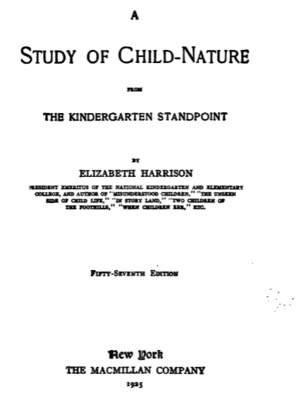
Harrison discusses educating a child's emotions and the roles toys have during play. She describes how toys direct emotional activity of the child, and "form a bridge between the realities and possibilities of life".
-

The Legend of the Christ Child
Elizabeth Harrison
Adapted from German and presented to members of the Mother's Department of the Chicago Kindergarten Training School, Art Institute, this children's Christmas story is about a child who wanders the streets on Christmas Eve looking to share Christmas with someone.
-

A List of Books For Children
Elizabeth Harrison
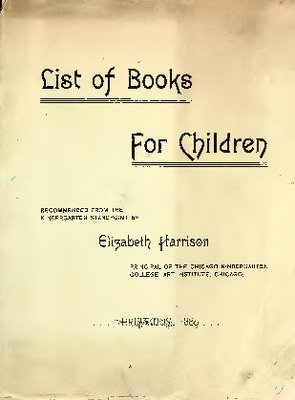
A list of books for children, recommended from the kindergarten standpoint by Elizabeth Harrison, Principal of the Chicago Kindergarten College, 1889. Includes suggestions for children under 6 years of age, children 6-8 years of age, and children aged 8-14.
-

The Story of Friedrich Froebel: Kindergarten Tales and Talks
Elizabeth Harrison
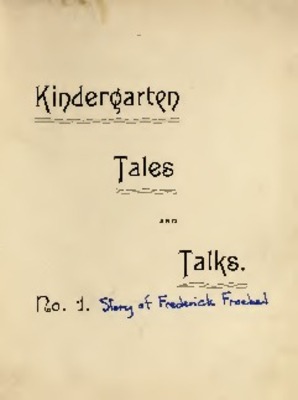
This children's story tell the life of Friedrich Froebel and how his care for a garden as a child relates to his idea of the Kindergarten as a place where a child could grow.